For many years, a large portion of systematic strategies relied on relatively low-frequency signals. These approaches worked well when they were under-explored, but over time they have been widely researched, increasingly arbitraged, and structurally compressed in edge.
As a result, a growing share of remaining opportunity has shifted toward market microstructure — order flow dynamics, liquidity fragmentation, queue positioning, adverse selection, and short-horizon volatility behavior that only exists at event-level resolution.
This creates a practical infrastructure challenge. Modern electronic markets generate large volumes of event-level data. A single liquid venue can produce millions to tens of millions of updates per day across trades and order book events. When extended across multiple symbols, venues, and multi-year horizons, datasets can become large depending on granularity and coverage.
At this point, the main challenge shifts from modeling to systems design and data engineering. Most quantitative teams respond with simplifications:
- reducing historical depth
- limiting universe size
- sampling tick data
- or pre-aggregating early in the pipeline
These choices reduce infrastructure complexity, but also remove much of the structure required for microstructure research.
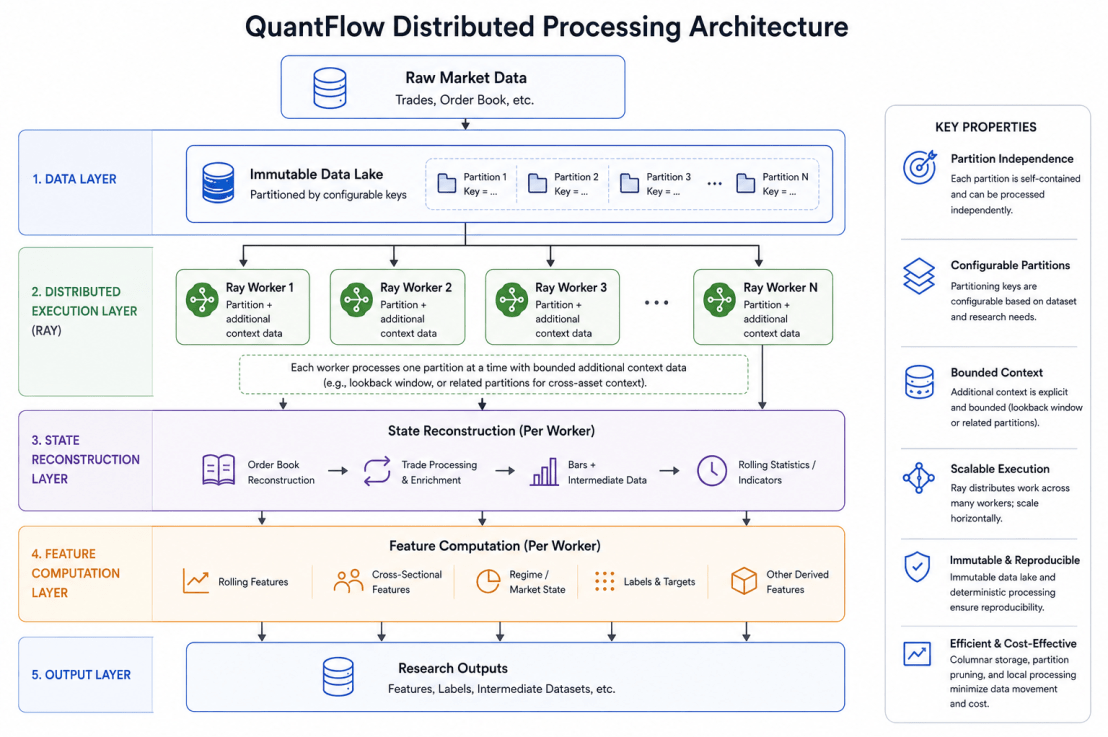
QuantFlow is designed to support this class of workload with a focus on explicit, modular execution rather than opaque system behavior.
System Design Overview
QuantFlow is built around a small set of design principles:
- partition-local computation where possible
- distributed execution across independent tasks
- immutable columnar storage formats
- bounded memory per processing stage
- explicit separation between state reconstruction and feature computation
Different stages of the pipeline are intentionally separated because they have different computational and memory characteristics.
Partitioning and Execution Model
The primary execution unit in QuantFlow is a partition defined by a configurable set of keys. These keys may include symbol, time window, or other grouping dimensions depending on the dataset and research design.
The time dimension is configurable and may range from hourly, daily, weekly, monthly, to yearly, depending on:
- asset liquidity
- event density
- and downstream workload requirements
This allows the system to represent different market structures without enforcing a fixed partitioning scheme.
Execution Model
Partitions are distributed across a Ray-based compute cluster.
Each worker processes one partition independently, optionally loading additional historical context when required via a configurable lookback window.
This results in a large number of independent tasks that can be scheduled dynamically across available compute resources.

Cross-Asset Structure via Partition Design
Cross-asset relationships can be represented directly through partition configuration when appropriate.
For example, correlation or sector-based features may be computed by defining partitions that include multiple assets within the same execution unit. This allows joint processing when asset grouping is meaningful.
At the same time, per-asset partitions remain valid for workflows where independent processing is more appropriate.
This makes cross-asset structure a design choice rather than a fixed pipeline stage.
State Reconstruction Layer
Within each partition, QuantFlow performs event-level state reconstruction, including:
- order book reconstruction
- trade enrichment
- multi-resolution bar generation
- incremental intraday statistics
This stage is implemented as a streaming process over event data.
This streaming model applies specifically to state reconstruction and does not extend to the full feature computation pipeline.
The output of this stage is a structured intermediate dataset used by downstream components.
Feature Computation Layer
Feature computation is performed after state reconstruction.
This includes:
- rolling statistical features
- regime indicators
- microstructure-derived signals
- cross-sectional normalization and transformations
This separation reflects an important design constraint: many features are inherently multi-pass or require broader context than a single streaming pass can provide.
As a result:
- state reconstruction remains streaming and partition-local
- feature computation operates on structured intermediate outputs
Storage Layer Design
QuantFlow uses immutable columnar storage backed by object storage and a table abstraction layer.
This provides:
- efficient columnar scans
- partition-level pruning
- compression for large historical datasets
However, practical constraints exist.
Fine-grained partitioning can lead to a large number of small files, especially for low-liquidity assets. This increases metadata overhead and can stress object storage listing performance.
To manage this, the system supports:
- configurable partition granularity
- periodic compaction of small files
- explicit table maintenance processes
These are operational considerations that must be handled in production environments.
Streaming Execution and Memory Boundaries
QuantFlow avoids full-dataset materialization where possible.
Instead, computation is structured into bounded stages:
- partition-level scans
- incremental processing within partitions
- batch-aligned outputs
This helps keep memory usage predictable at the task level.
However, memory requirements depend on workload characteristics. Long lookback windows or complex feature sets increase resource usage and must be explicitly accounted for.
Rather than assuming fixed constraints, the system relies on configurable partitioning and workload-aware execution design.

