Tag: Internals

Parquet for Spark Deep Dive (3) – Parquet Encoding

Parquet for Spark Deep Dive (3) – Parquet Encoding

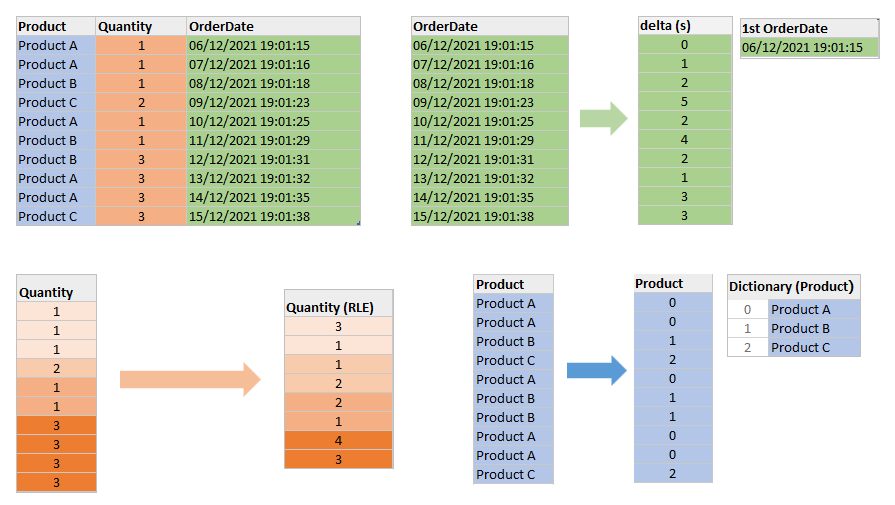
As promised in the last blog post, I am going to dedicate a whole blog post to explore Parquet encoding, focusing on finding answers to the following questions: Why does Parquet using encoding?What encoding algorithms are used in Parquet?How does Parquet implement encoding?How does Parquet choose encoding algorithms? Why does Parquet using encoding? Short answer: … Continue reading Parquet for Spark Deep Dive (3) – Parquet Encoding
Parquet for Spark Deep Dive (2) – Parquet Write Internal

Parquet for Spark Deep Dive (2) – Parquet Write Internal

This blog post continues the Delta Lake table write joruney into the parquet file write internal. As described in the last blog post, a ParquetOutputWriter instance is created and call the Parquet API for writing a partitoin of the Spark SQL dataframe into Parquet file. From this point on, the Delta table write journey steps … Continue reading Parquet for Spark Deep Dive (2) – Parquet Write Internal

Parquet for Spark Deep Dive (1) – Table Writing Journey Overview

In this blog post, I am going to explore the full delta table writing journey, from Spark SQL Dataframe to the underneath Parquet files. The diagram above shows the whole journey of a table writing operation (some steps have been simplified or abstracted in order to make the whole table writing journey presentable in the … Continue reading Parquet for Spark Deep Dive (1) – Table Writing Journey Overview

How Azure Storage Cheats Over the CAP Theorem

Microsoft claims Azure Storage providing both high availability and strong consistency. It sounds good but obviously violates the CAP theorem as the 'P' (network partitioning) is not avoidable in the real world. In theory, you can only achieve either high availability or strong consistency in a distributed storage system. I have done a bit of … Continue reading How Azure Storage Cheats Over the CAP Theorem

Create Custom Partitioner for Spark Dataframe

Spark dataframe provides the repartition function to partition the dataframe by a specified column and/or a specified number of partitions. However, for some use cases, the repartition function doesn't work in the way as required. For example, in the previous blog post, Handling Embarrassing Parallel Workload with PySpark Pandas UDF, we want to repartition the traveller dataframe so … Continue reading Create Custom Partitioner for Spark Dataframe