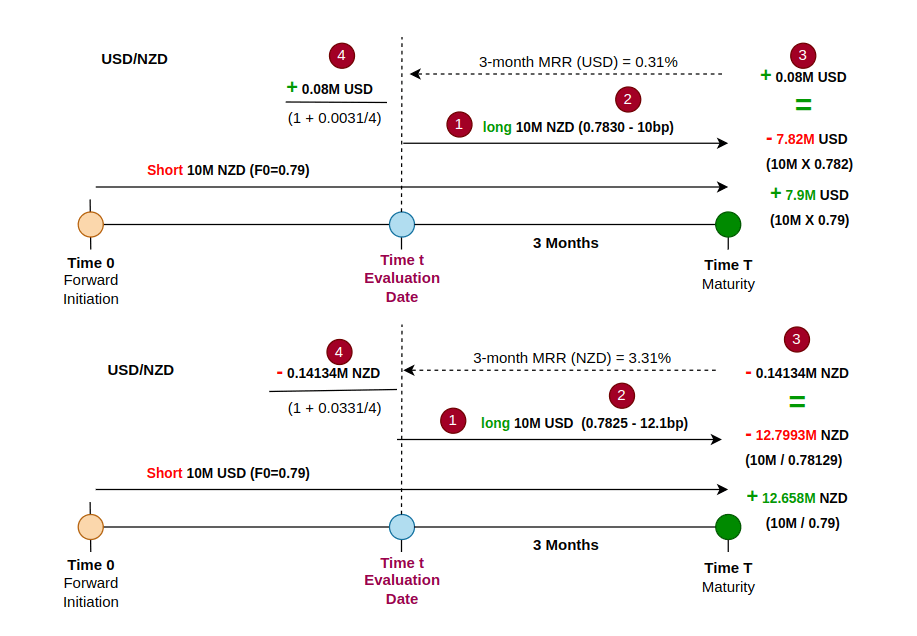
Mark-to-Market (MTM) is the process of valuing an asset, liability, or financial instrument, such as a forex forward contract, at its current market price rather than its book value or historical cost. The calculated MTM value represents the profit or loss that would be realised if the contract were settled at the current market exchange … Continue reading Mark-to-Market of Forex Forward Contract
Tag: Derivatives
Pricing Credit Default Swap with QuantLib
In the previous blog, I manually crafted the Python code for pricing CDS without relying on third-party quant libraries. While this approach was useful for understanding the underlying algorithm, in practice, it's preferable to use a mature, validated library for standardisation when available. In this blog post, I will revisit the CDS pricing exercise using … Continue reading Pricing Credit Default Swap with QuantLib
Pricing Credit Default Swaps
Some Basics of Credit Default Swap (CDS) A Credit Default Swap is a credit derivative instrument that functions as a form of insurance, where one party pays a series of premiums to another party in exchange for protection against the risk of default by the issuer of the underlying debt. Parties Involved: Protection Buyer - Owns … Continue reading Pricing Credit Default Swaps
Pricing Capped and Floored Floating-Rate Bonds with QuantLib
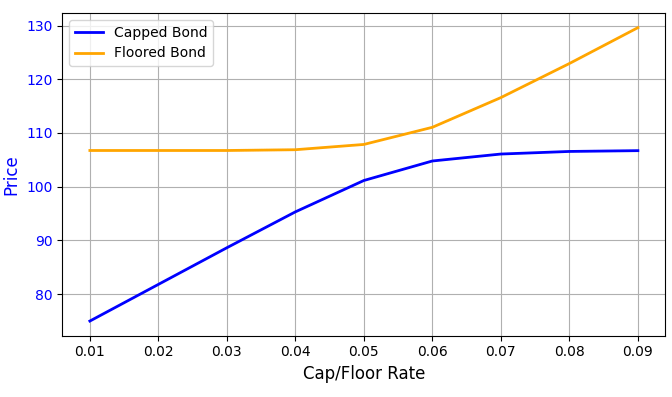
The concept of "capped and floored floating-rate bonds" is covered in Section 9, Module 3 of the CFA Fixed Income curriculum. Compared to fixed-rate bonds, floating-rate bonds have distinct features that make their valuation and pricing more complex. In this blog post, I will begin by discussing the key features of floating-rate bonds and then … Continue reading Pricing Capped and Floored Floating-Rate Bonds with QuantLib
Pricing Callable and Putable Bonds with QuantLib
The valuation and analysis of bonds with embedded options is the most focused topic discussed in the CFA Level 2 Fixed Income curriculum. These types of bonds, such as callable and puttable bonds, introduce an additional layer of complexity due to the optionality features embedded within the instrument. In this blog post, I will discuss … Continue reading Pricing Callable and Putable Bonds with QuantLib
Implied Volatility Calculation
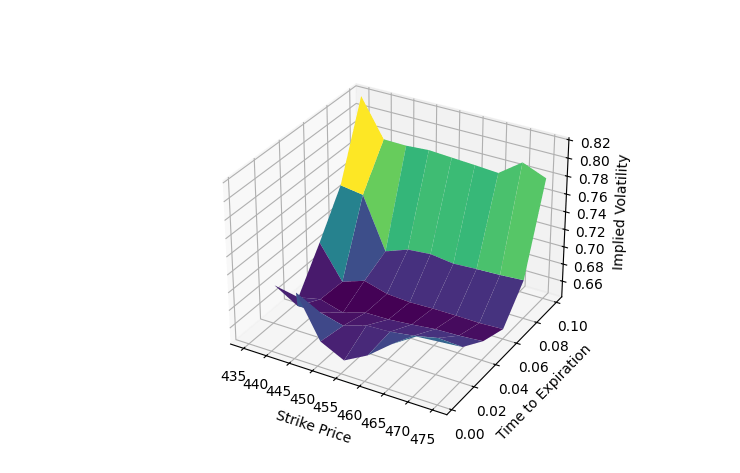
Implied volatility (IV) is a key metric in options trading and risk management. It is derived from the market price of an option and reflects the market's consensus view on the expected future volatility of the underlying asset. There is a lot of information that can be interpreted from IV. For example, high IV often … Continue reading Implied Volatility Calculation
Dynamic Delta Hedging with DolphinDB
Delta hedging is an options trading strategy used to maintain a delta neutral position by ensuring that the overall delta of a portfolio is zero, so that the price fluctuations of the underlying asset do not significantly impact the position’s value. Dynamic delta hedging involves continuously adjusting the hedging position to account for changes in … Continue reading Dynamic Delta Hedging with DolphinDB
Real-Time Option Greeks Calculation with DolphinDB
In the previous blog post, we explored option Greeks calculations using the BSM model. In this post, I’ll have some coding fun by implementing real-time Greeks calculations with the formulas from the last post, but this time using the DolphinDB stream processing framework. Here, I plan to mimic a portfolio consisting of option contracts with … Continue reading Real-Time Option Greeks Calculation with DolphinDB
Options Greeks
Options Greeks are key metrics used in options trading and risk management to measure how sensitive an option's price is a series of factors, including: Delta - measures the sensitivity of an option's price to the changes in the underlying asset's price. Gamma - measures the change rate of an option's Delta in respect to … Continue reading Options Greeks
Swaption Valuation
A swaption is an option on an interest rate swap. As previously discussed, an interest rate swap involves two parties: the fixed-rate payer (who receives the floating rate) and the fixed-rate receiver (who pays the floating rate). A swaption grants the holder the right, but not the obligation, to enter into a swap contract as … Continue reading Swaption Valuation


You must be logged in to post a comment.