Tag: Risk Management

The Monte Carlo Method of VaR Estimation

The Monte Carlo Method of VaR Estimation

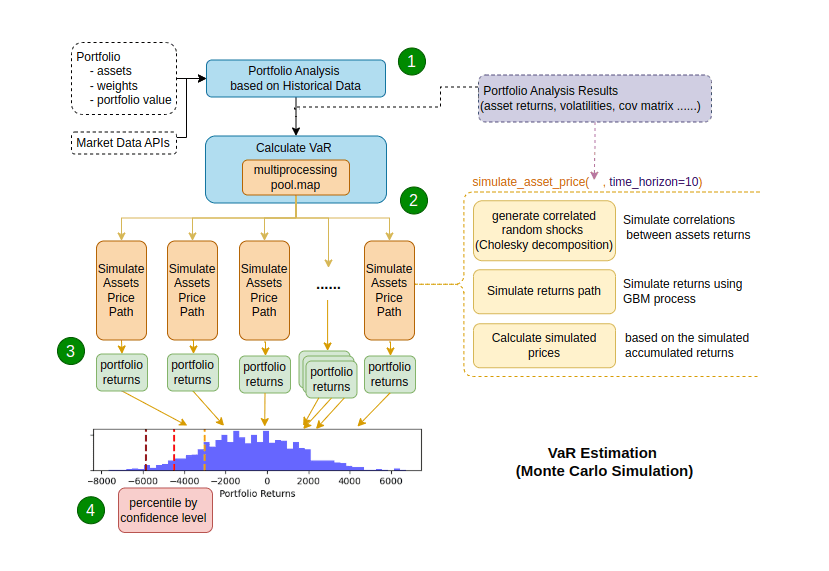
In the previous blog post, we explored the Parametric Method for estimating Value at Risk (VaR). While the parametric method offers the advantage of optimal computational efficiency, it relies on strict assumptions, particularly that returns follow a specific distribution (e.g., normal distribution). For complex portfolios, nonlinear instruments, and scenarios where flexibility and precision are critical, the parametric method may not be suitable. In such … Continue reading The Monte Carlo Method of VaR Estimation

The Parametric Method of VaR Estimation

The Parametric Method of VaR Estimation

In the previous blog post, we explored the Historical Method of VaR Estimation. The historical method is simple and intuitive; however, it relies on the assumption that financial markets will repeat historical patterns, disregarding structural changes in market conditions. This limitation makes the historical method less practical in real-world scenarios. In this blog post, I will … Continue reading The Parametric Method of VaR Estimation

VaR Overview and the Historical Method

VaR Overview and the Historical Method

Value at Risk (VaR) is arguably the most widely used metric for risk management. It quantifies the potential loss in the value of a portfolio over a certain period. In this blog post, I will first provide an overview of VaR, clarifying its definition and discussing its advantages and disadvantages. Then, I will implement Python code … Continue reading VaR Overview and the Historical Method

Options Greeks

Options Greeks

Options Greeks are key metrics used in options trading and risk management to measure how sensitive an option's price is a series of factors, including: Delta - measures the sensitivity of an option's price to the changes in the underlying asset's price. Gamma - measures the change rate of an option's Delta in respect to … Continue reading Options Greeks