Background
Over time, I encountered many different challenges across the financial data world. Although they often appeared to be separate problems, I increasingly found that many could be traced back to the same root cause: financial meaning was fragmented across systems, documents, models, mappings, rules and people.
Financial institutions already hold enormous amounts of data and deep business knowledge. However, there is often no consistent way to connect the two and make that knowledge reusable across the organisation.
A product may be defined one way by the business, represented differently in a canonical model and stored differently again across several physical systems. The rules governing that product may sit in documentation, application code, operational procedures or the knowledge of individual subject-matter experts.
Modern data platforms have made significant progress in storing, processing and distributing data. But they do not automatically make the meaning of that data explicit.
I gradually came to see the institutional semantic layer as the missing piece: a layer that connects business knowledge to the enterprise data estate and makes that knowledge understandable and usable by both people and AI.
The semantic layer is not a new idea. Ontologies, canonical models, metadata platforms and knowledge graphs have existed for many years. The difficulty was rarely the absence of possible technologies. The real challenge was finding a sufficiently strong business case to justify the effort.
Financial institutions always have more immediate priorities: regulatory change, system migration, reporting deadlines, control remediation, new data feeds and business application delivery. Building a reusable semantic layer requires significant participation from business experts, data architects and technology teams, while its value is distributed across many future use cases and can be difficult to measure directly.
The investment is visible. The benefits are broader, longer term and harder to attribute to one project.
For this reason, the semantic layer was often considered valuable in principle but difficult to prioritise in practice.
AI changes this position.
To deliver real value inside a financial institution, AI must understand more than documents, database schemas and isolated data fields. It needs to understand the institution’s products, processes, relationships, mappings, rules and controls.
This creates a much stronger business case for organising institution-specific knowledge.
AI can also help control the effort. It can assist with discovering concepts, interpreting schemas and documents, comparing terminology, proposing mappings, identifying relationships and supporting the maintenance of semantic assets. The results must still be reviewed and governed, but the work can become more incremental and achievable.
AI therefore changes both sides of the equation:
AI makes the institutional semantic layer more necessary and more achievable.
This is the background from which the Finsight initiative emerged.
Belief
Belief 1 – AI will transform financial services.
I believe AI will change more than individual tasks or personal productivity. It can transform how financial institutions understand data, investigate problems, apply accumulated knowledge and support business decisions.
Belief 2 – AI’s ability to understand institution-specific knowledge is the key enabler.
Powerful models and access to large amounts of enterprise data are not sufficient on their own.
AI becomes genuinely useful when it can understand what an institution means by a product, process, data element, rule or control—and how these things are connected within that institution’s environment.
Financial institutions already possess this knowledge. The challenge is to organise it so that AI can understand and use it consistently.
Belief 3 – AI trust and safety is the ultimate condition for enterprise adoption.
AI trust and safety were not originally part of my thinking for Finsight. My initial focus was almost entirely on financial ontology, semantic modelling and the runtime use of institutional knowledge.
However, I came to realise that trust and safety are the real threshold for enterprise AI. Organisations and their people must be able to rely on both the outputs and the behaviour of AI systems. Without that trust, AI does not simply fail to create value—it can create new risks. Trust and safety must therefore shape the architecture from the beginning.
Aim
Help financial institutions build the data foundations that enable AI to deliver real business value.
By a financial data foundation, I do not mean simply adding an AI interface to an existing data platform.
I mean organising financial meaning, institution-specific knowledge, data structures, mappings, relationships, rules and evidence so that AI can understand the financial data world and work with it responsibly.
The objective is not to replace the institution’s existing data estate. It is to make the knowledge already distributed across that estate explicit, connected and usable by AI.
Principles
Principle 1 – Focus on semantics and safety.
The enterprise AI landscape is extremely broad. It includes infrastructure, data platforms, models, agent frameworks, application development, workflows, user experience, security and governance.
Finsight will not attempt to cover the entire stack.
It will focus on the two areas I believe are foundational and require deep specialisation: the institutional semantic layer and AI safety.
Principle 2 – Build depth, not breadth.
A small initiative cannot credibly become expert in every part of enterprise AI.
Cloud providers, model developers, data-platform vendors and application frameworks will continue to develop rapidly. Trying to compete across all these areas would dilute Finsight’s purpose and engineering effort.
I would rather Finsight develop genuine depth in financial ontology, semantic modelling, semantic runtime capabilities and AI control than provide shallow coverage across a much broader technology landscape.
The institutional semantic layer is also where a significant part of the organisation’s enduring value resides. Infrastructure, models and application frameworks will continue to change, but an institution’s understanding of its products, processes, data and rules is much more stable and institution-specific.
The enterprise AI stack spans infrastructure, the enterprise data estate, AI models, agents and applications. Finsight deliberately concentrates on the institutional semantic layer rather than attempting to build every layer.
Principle 3 – Put AI safety and semantic governance first.
Institutional meaning cannot become an uncontrolled collection of model-generated suggestions. Definitions, mappings, relationships and rules must remain explicit, reviewable and governed.
The same principle applies to AI execution.
Safety must influence how capabilities are defined, how data is accessed, how models and tools are invoked, when approval is required and how execution outcomes are evidenced.
Semantic governance and AI safety should therefore shape the architecture from the beginning rather than be added after an AI application has already been built.
Principle 4 – Augment the existing estate, rather than replace it.
Some visions of AI-native transformation assume that existing systems, processes and technology ecosystems must be replaced. However, I do not believe this is a practical starting point for most financial institutions.
Their existing estates contain decades of business logic, operational knowledge, regulatory controls and technology investment. Replacing that estate would be expensive, disruptive and difficult to justify.
A more achievable approach is to introduce a lightweight, flexible and extensible semantic layer around existing systems and processes. This layer can organise their meaning, connect their knowledge and make both available to AI without requiring the underlying estate to be rebuilt.
For Finsight, AI-native does not mean greenfield replacement. It means enabling the existing financial data world to support AI in a more structured, understandable and governable way.
Products
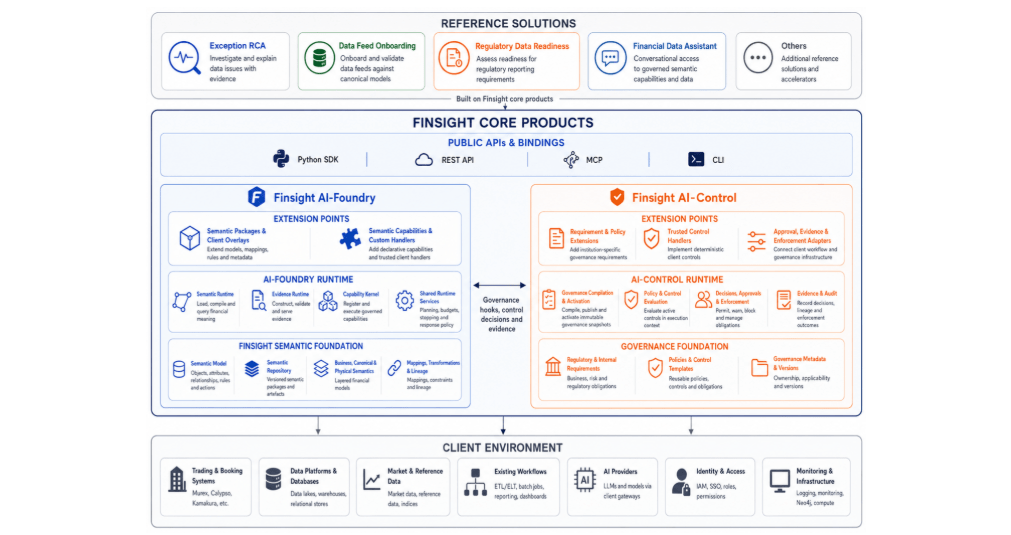
These beliefs and principles have led me to organise the Finsight initiative around two focused products.

Finsight AI-Foundry
Finsight AI-Foundry represents the semantic foundation of the initiative.
It brings together the Finsight Semantic Foundation, the runtime capabilities required to operationalise financial meaning and reusable platform capabilities through which AI applications can work with semantic context and evidence.
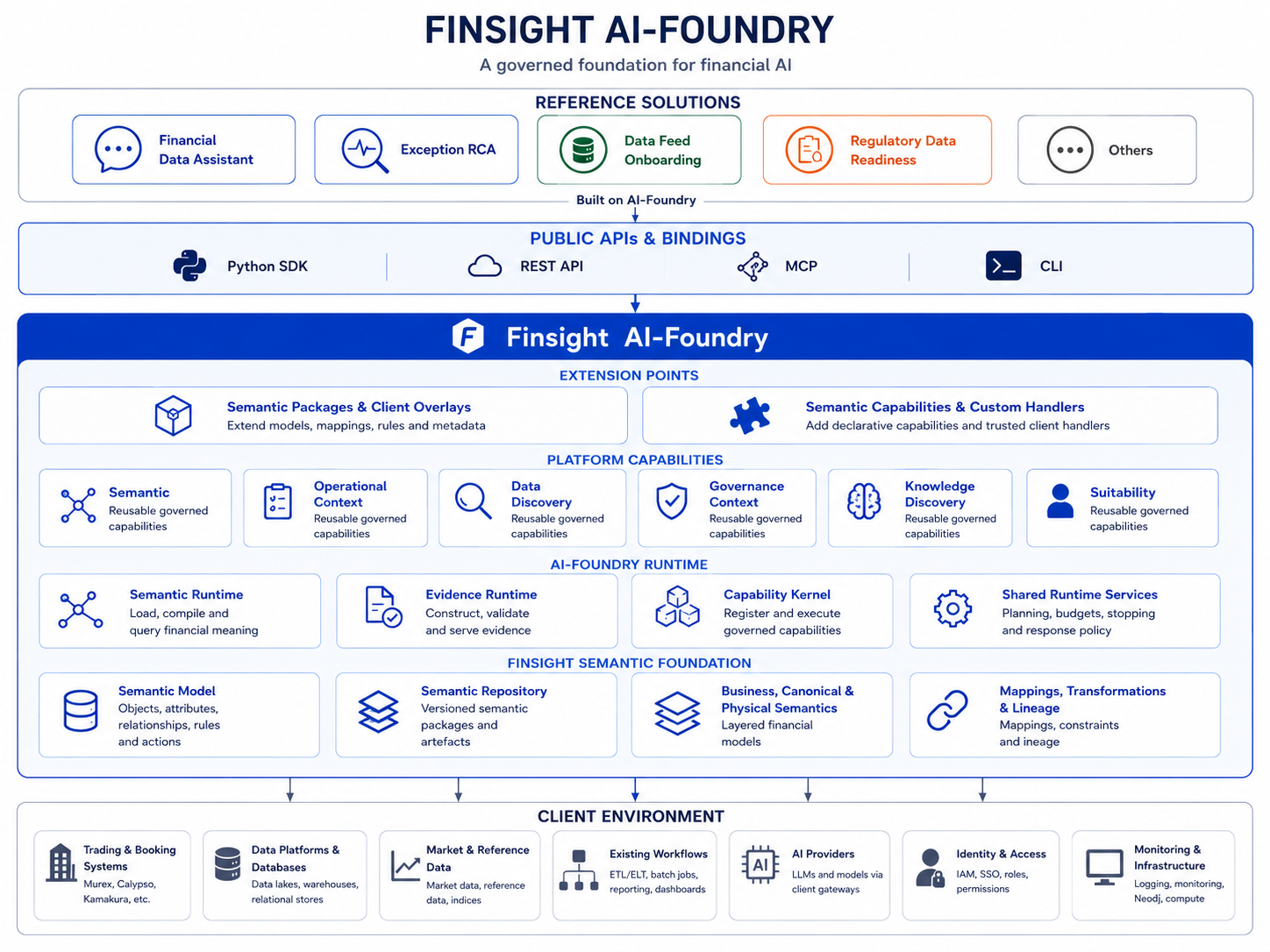
The Semantic Foundation and the runtime are not separate products. Both sit within the AI-Foundry product boundary.
The Foundation defines and stores governed financial meaning. The Runtime loads, validates, compiles, queries and uses that meaning during execution.
AI-Foundry is therefore focused on making institution-specific financial knowledge explicit, operational and usable by AI.
Finsight AI-Control
Finsight AI-Control represents the safety and control foundation of the initiative.
It emerged later, after I realised that semantic grounding alone would not be sufficient for real institutional adoption.
AI-Control is intended to help make governance requirements, runtime controls, approval conditions, enforcement decisions and control evidence part of the execution architecture.
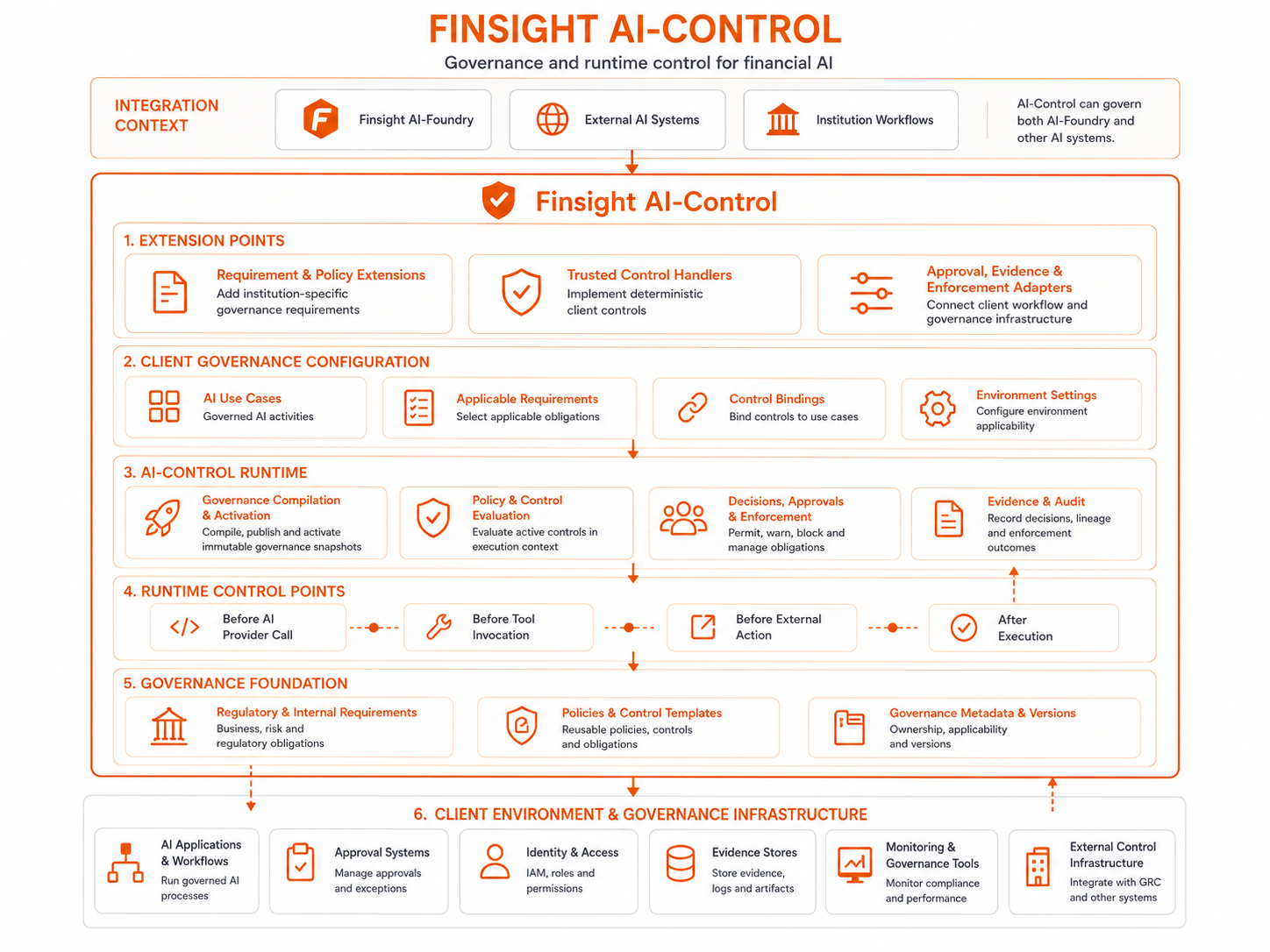
It can work with AI-Foundry, but it remains an independent product so that the same control approach can also be applied to other AI systems.
A focused direction
Finsight remains an evolving initiative, but its direction is becoming clear.
I believe AI will transform financial services.
I believe AI’s ability to understand institution-specific knowledge is the key enabler.
I also believe AI safety is the ultimate condition for moving enterprise AI from experimentation into real operation.
The aim of Finsight is not to build every part of the enterprise AI stack. It is to focus on the foundations I believe matter most: making financial knowledge understandable and usable by AI, and ensuring that AI can operate within explicit and enforceable boundaries.
That focus has led to Finsight AI-Foundry and Finsight AI-Control. I plan to dedicate the next two articles to introduce those two products.

