The Residual Income Model is one of the equity valuation methods covered in the CFA Level 2 curriculum. This method estimates the intrinsic value of a stock based on the stock's current book value, plus the present value of expected future residual income. Residual income represents the income generated by the company in excess of … Continue reading General Residual Income Model for Equity Valuation
Tag: Pricing
Equity Risk Premium Estimates using Forward-Looking Approach
In the previous blog post, we explored the historical approach for estimating the Equity Risk Premium (ERP). The historical approach is a widely used method that is simple to implement. However, it relies on the assumption that the future will resemble the past, which often does not hold true in financial markets. In this blog post, we will … Continue reading Equity Risk Premium Estimates using Forward-Looking Approach
Equity Risk Premium Estimates using Historical Approach
In this blog post, I will begin exploring the topic of equity valuation, one of the most emphasised areas in the CFA Level 2 curriculum. Before delving into the various equity valuation models, I intend to use this and the next few blog posts to discuss how to estimate the equity risk premium (ERP) and … Continue reading Equity Risk Premium Estimates using Historical Approach
Pricing Credit Default Swap with QuantLib
In the previous blog, I manually crafted the Python code for pricing CDS without relying on third-party quant libraries. While this approach was useful for understanding the underlying algorithm, in practice, it's preferable to use a mature, validated library for standardisation when available. In this blog post, I will revisit the CDS pricing exercise using … Continue reading Pricing Credit Default Swap with QuantLib
Pricing Credit Default Swaps
Some Basics of Credit Default Swap (CDS) A Credit Default Swap is a credit derivative instrument that functions as a form of insurance, where one party pays a series of premiums to another party in exchange for protection against the risk of default by the issuer of the underlying debt. Parties Involved: Protection Buyer - Owns … Continue reading Pricing Credit Default Swaps
Pricing Capped and Floored Floating-Rate Bonds with QuantLib
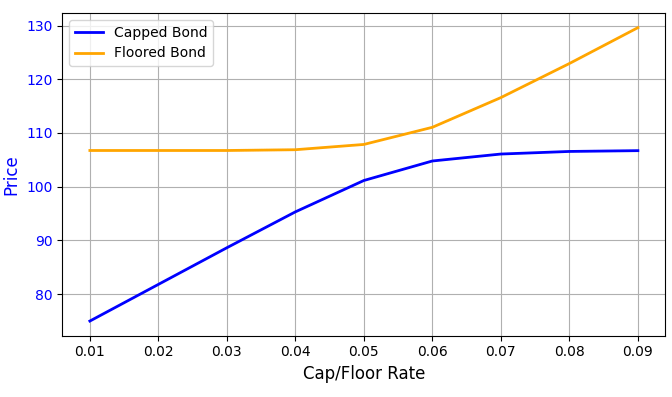
The concept of "capped and floored floating-rate bonds" is covered in Section 9, Module 3 of the CFA Fixed Income curriculum. Compared to fixed-rate bonds, floating-rate bonds have distinct features that make their valuation and pricing more complex. In this blog post, I will begin by discussing the key features of floating-rate bonds and then … Continue reading Pricing Capped and Floored Floating-Rate Bonds with QuantLib
Pricing Callable and Putable Bonds with QuantLib
The valuation and analysis of bonds with embedded options is the most focused topic discussed in the CFA Level 2 Fixed Income curriculum. These types of bonds, such as callable and puttable bonds, introduce an additional layer of complexity due to the optionality features embedded within the instrument. In this blog post, I will discuss … Continue reading Pricing Callable and Putable Bonds with QuantLib
Swaption Valuation
A swaption is an option on an interest rate swap. As previously discussed, an interest rate swap involves two parties: the fixed-rate payer (who receives the floating rate) and the fixed-rate receiver (who pays the floating rate). A swaption grants the holder the right, but not the obligation, to enter into a swap contract as … Continue reading Swaption Valuation
Interest Rate Options Valuation
Interest rate options are options based on interest rates, where the underlying asset is a reference interest rate, typically in the form of a Forward Rate Agreement (FRA). For instance, an interest rate call option on a 3-month MRR (market reference rate) with 9 months to expiration would have a 3-month FRA rate expiring in … Continue reading Interest Rate Options Valuation
Futures Options Pricing with Black Model
In the last blog post, we explored the Black-Scholes-Merton model and learned that it is the industry standard for pricing option contracts. However, the BSM model is designed for options on stocks and similar spot market assets, and it is not directly applicable for pricing futures options contracts, mainly due to the following differences between … Continue reading Futures Options Pricing with Black Model


You must be logged in to post a comment.