In the previous article, we learned to pause before turning every business difference into an ontology construct. A difference might concern what kind of thing something is, how it is related to something else, how it changes, how somebody classifies it, or what a particular context makes relevant. Once we start noticing those distinctions, however, … Continue reading Financial Ontology Modelling for Everyone (9): How Much Meaning Should We Model?
Tag: Financial Semantics
Financial Ontology Modelling for Everyone (8): Difference ≠ Type
In the previous article, we started with a familiar security record and kept asking what the data was actually trying to describe. That led to a simple but important principle: Do not confuse the representation with the thing being represented. A table, field, identifier or message is a representation. Before turning that representation into ontology … Continue reading Financial Ontology Modelling for Everyone (8): Difference ≠ Type
Financial Ontology Modelling for Everyone (7): What Are We Actually Modelling?
Suppose you open a security-master table and see: SecurityId ISIN IssuerId ProductType Currency MaturityDate Status It is tempting to think that the modelling problem is already visible. There is a security, it has an issuer, a product type, a currency, a maturity date and a status. Perhaps we just need to turn the table into … Continue reading Financial Ontology Modelling for Everyone (7): What Are We Actually Modelling?
Financial Ontology Modelling for Everyone (6): What Kinds of Financial Meaning Do We Need to Model?
So far, we have argued that financial ontology modelling should begin with the financial world rather than with ontology syntax. That leaves a natural question: What exactly are we going to model? The answer is broader than securities, trades or legal entities. A financial institution does not deal only with static things. Things enter relationships, … Continue reading Financial Ontology Modelling for Everyone (6): What Kinds of Financial Meaning Do We Need to Model?
Financial Ontology Modelling for Everyone (5): Finance Is Hard. Ontology Should Not Be.
Finance has a reputation for being difficult, and for good reason. Even apparently simple concepts become complicated once we look closely at the real financial world. A bond involves an issuer, a security, identifiers, contractual obligations, payments, prices and lifecycle events. A derivative can bring in multiple parties, economic terms, rights, obligations, amendments, novations and … Continue reading Financial Ontology Modelling for Everyone (5): Finance Is Hard. Ontology Should Not Be.
Financial Ontology Modelling for Everyone (4): The End of the Technology-Only Financial Technologist
For a long time, financial technology supported a fairly clear division of labour. Business people understood the financial problem, analysts translated it into requirements, architects designed the system, and developers implemented it. That model was never as clean as the organisation chart suggested, but it worked well enough. A developer could spend years building trading … Continue reading Financial Ontology Modelling for Everyone (4): The End of the Technology-Only Financial Technologist
Financial Ontology Modelling for Everyone (3): AI Makes Shared Meaning Everyone’s Problem
In the previous article, we looked at a problem that sits underneath many disappointing enterprise AI applications. The organisation often already has much of the knowledge the AI needs, but that knowledge is scattered across people, systems, code, policies and operating practices. For years, financial institutions have been able to live with this arrangement. Different … Continue reading Financial Ontology Modelling for Everyone (3): AI Makes Shared Meaning Everyone’s Problem
Financial Ontology Modelling for Everyone (2): Your Organisation Knows More Than Its AI Does
In the previous article, we looked at a strange feature of modern financial AI. Large language models can know an extraordinary amount about finance. They can explain products, markets, settlement, corporate actions, valuation and risk in impressive detail. Yet once we ask them to solve a real problem inside a financial institution, that knowledge often … Continue reading Financial Ontology Modelling for Everyone (2): Your Organisation Knows More Than Its AI Does
Financial Ontology Modelling for Everyone (1): Your AI May Know Finance Better Than You Think — and Still Be Useless
For a while, the story of enterprise AI was mostly about the model. Get access to a stronger large language model, give it more context, connect it to your documents and systems, and the quality of the application should improve. That story is now changing. More people have realised that a powerful model is not … Continue reading Financial Ontology Modelling for Everyone (1): Your AI May Know Finance Better Than You Think — and Still Be Useless
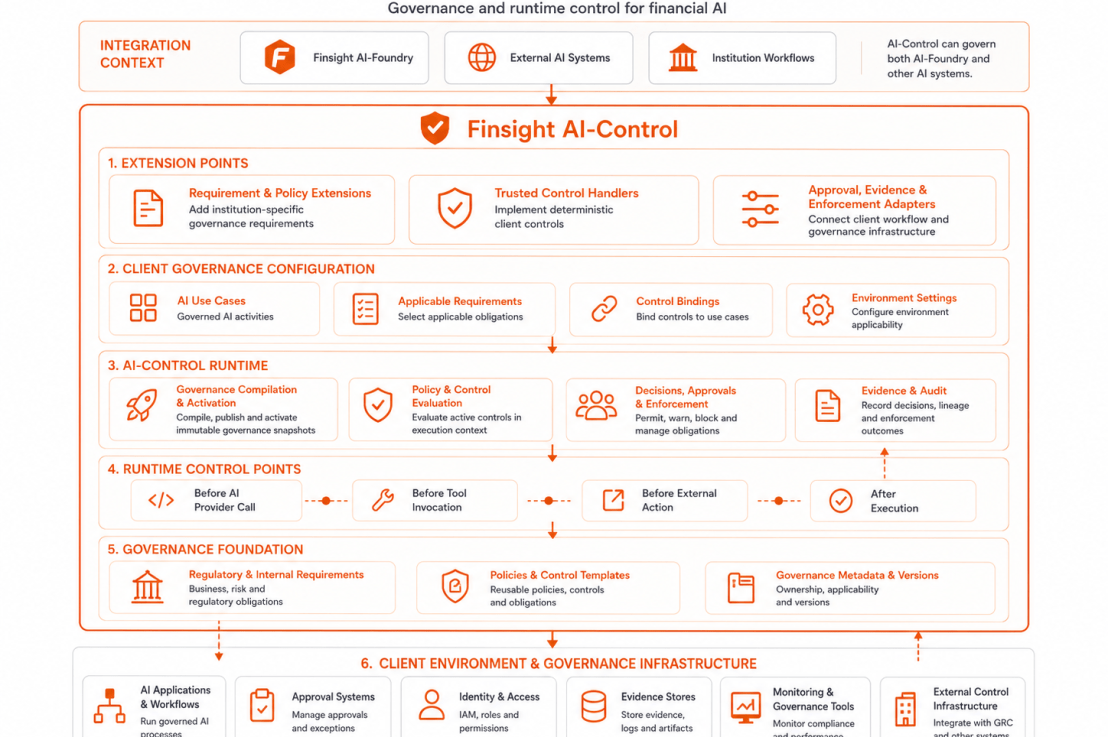
AI-Native Financial Data Foundation (40): Finsight AI-Control — Governance and Runtime Control for Financial AI
The previous article discussed Finsight AI-Foundry and the foundations required to make financial meaning, evidence and reusable capabilities available to AI applications. This article focuses exclusively on Finsight AI-Control. As with the previous article, it is not intended to be a user guide or a detailed product manual. Formal documentation covering configuration, APIs, administration and … Continue reading AI-Native Financial Data Foundation (40): Finsight AI-Control — Governance and Runtime Control for Financial AI


You must be logged in to post a comment.