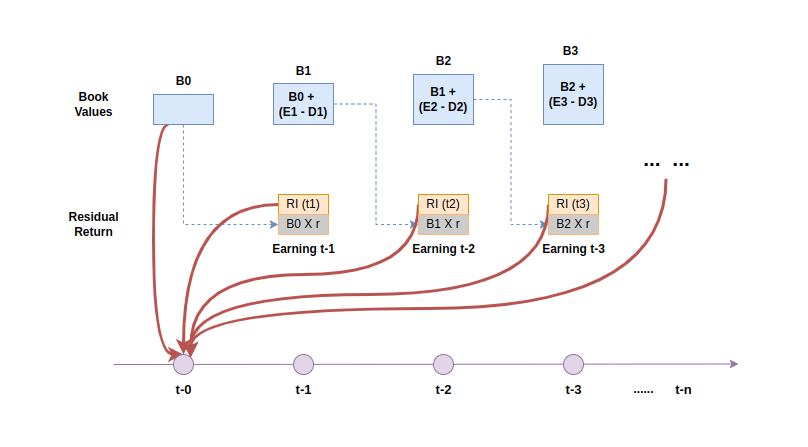
The Residual Income Model is one of the equity valuation methods covered in the CFA Level 2 curriculum. This method estimates the intrinsic value of a stock based on the stock's current book value, plus the present value of expected future residual income. Residual income represents the income generated by the company in excess of … Continue reading Coding towards CFA (44) – General Residual Income Model for Equity Valuation→
In the previous blog post, we explored the historical approach for estimating the Equity Risk Premium (ERP). The historical approach is a widely used method that is simple to implement. However, it relies on the assumption that the future will resemble the past, which often does not hold true in financial markets. In this blog post, we will … Continue reading Coding towards CFA (43) – Equity Risk Premium Estimates using Forward-Looking Approach→
In this blog post, I will begin exploring the topic of equity valuation, one of the most emphasised areas in the CFA Level 2 curriculum. Before delving into the various equity valuation models, I intend to use this and the next few blog posts to discuss how to estimate the equity risk premium (ERP) and … Continue reading Coding towards CFA (42) – Equity Risk Premium Estimates using Historical Approach→
This is another code-less blog post in my "Coding Towards CFA" series. The concepts of the Cobb-Douglas Production Function and the Neoclassical Growth Model are too important to skip, which is essential for building a strong foundation in economics and of course for pass on the CFA exam. Neoclassical growth theory is a framework for understanding economic growth, analysing how the … Continue reading Coding towards CFA (41) – Cobb-Douglas Production Function and Neoclassical Growth Model→
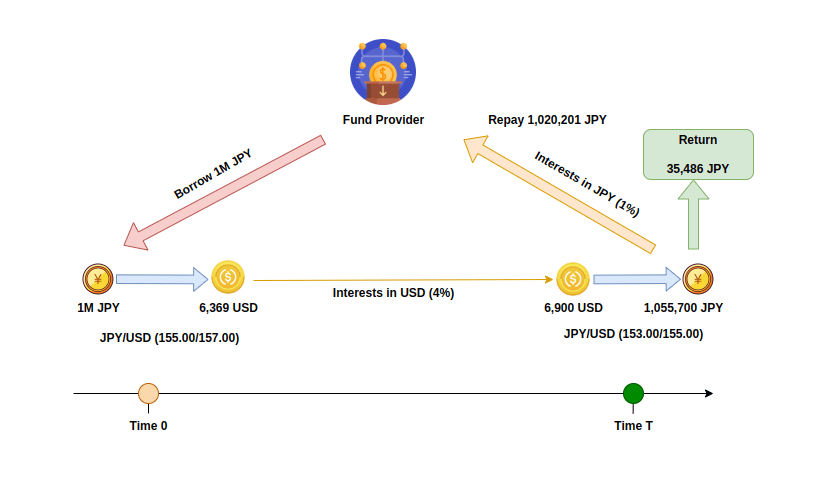
As discussed in the previous blog post, under the Uncovered Interest Rate Parity condition, the expected change in the exchange rate between two currencies should theoretically offset the interest rate differential between them. This would eliminate any opportunity for investors to profit from interest rate differentials. Fortunately, in the real world, uncovered Interest Rate Parity … Continue reading Coding towards CFA (40) – FX Carry Trade→
This is the first code-less blog post in my Coding Towards CFA series. I’ve included this topic because of the importance of International Parity Conditions, which form the theoretical foundation of forex trading. These conditions are essential for gaining a deep understanding of equilibrium pricing, enabling investors to navigate the FX market more effectively. One of the main … Continue reading Coding towards CFA (39) – International Parity Conditions→
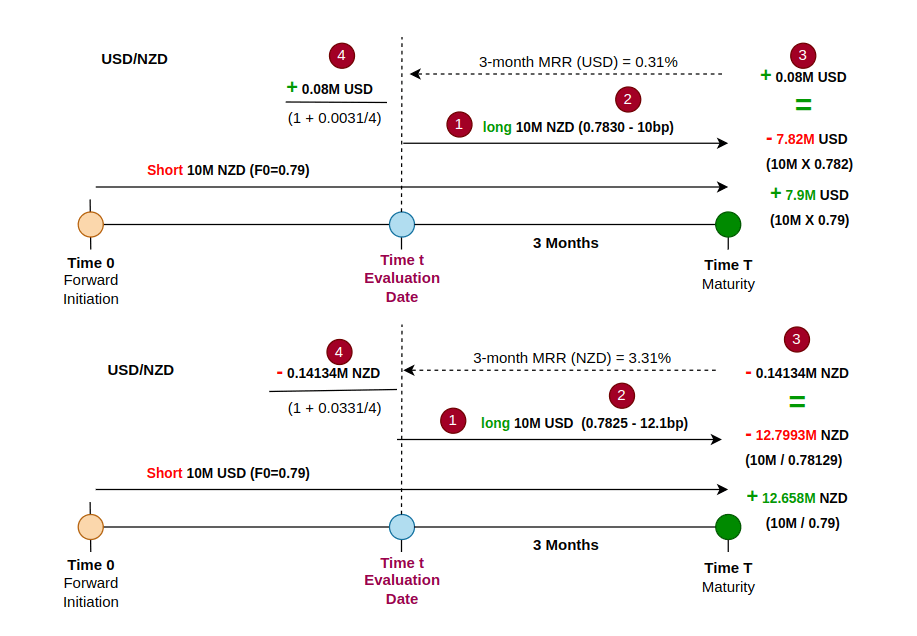
Mark-to-Market (MTM) is the process of valuing an asset, liability, or financial instrument, such as a forex forward contract, at its current market price rather than its book value or historical cost. The calculated MTM value represents the profit or loss that would be realised if the contract were settled at the current market exchange … Continue reading Coding towards CFA (38) – Mark-to-Market of Forex Forward Contract→
Triangular arbitrage is a strategy used to exploit inefficiencies in the currency markets by executing a series of trades across three currencies in different markets. Let’s assume we now observe the following quotes for currency pairs from the interbank market and dealers. We want to analyse whether there is any arbitrage opportunity. Interbank Market Quotes … Continue reading Coding towards CFA (37) – Triangular Arbitrage in Forex Trading→
Performance attribution is discussed in the CFA Portfolio Management curriculum, specifically in Module 2, Section 2: "Active Management and Value Added". Performance attribution is a process used to decompose the "value added," i.e., the excess return relative to a benchmark, into different sources. In the CFA curriculum, a simplified Brinson model is presented, which discusses the basic calculations of … Continue reading Coding towards CFA (36) – Performance Attribution with Brinson Model in DolphinDB and Python→
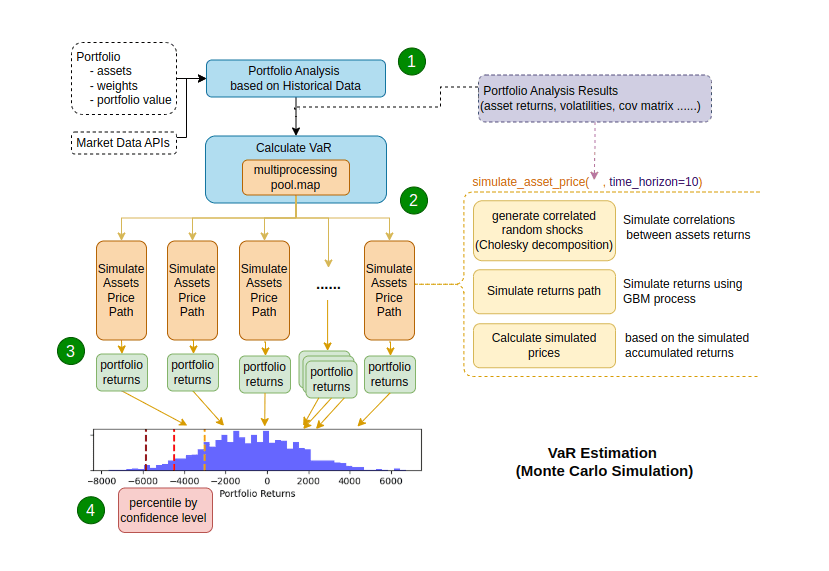
In the previous blog post, we explored the Parametric Method for estimating Value at Risk (VaR). While the parametric method offers the advantage of optimal computational efficiency, it relies on strict assumptions, particularly that returns follow a specific distribution (e.g., normal distribution). For complex portfolios, nonlinear instruments, and scenarios where flexibility and precision are critical, the parametric method may not be suitable. In such … Continue reading Coding towards CFA (35) – The Monte Carlo Method of VaR Estimation→





 Data Ninjago (Finsight-Tech Blogs)
You must be logged in to post a comment.