After writing the previous article, What is a Financial Product at all?, I originally planned to move directly into a concrete overview example of ISDA CDM. However, while researching the semantic layer of QuantFlow, I came across an article about ontology modelling and AI-native applications. Although the article is not specifically about finance, I found … Continue reading AI-Native Financial Data Foundation (4) – Literature Review: From Ontology to AI-Native Applications
Author: Linxiao Ma
AI-Native Financial Data Foundation (3) – What is a Financial Product at all?
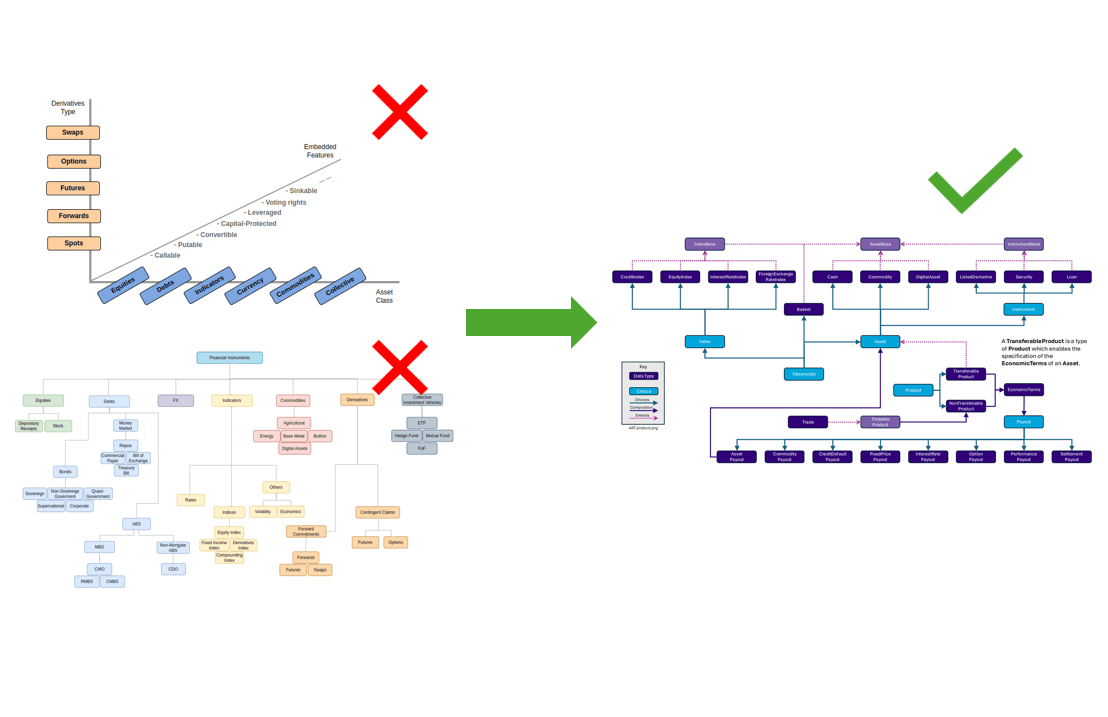
A few years back, I made an attempt to define and classify financial products from a data modelling perspective. I wrote about this in one of my earlier blog posts, Buy-Side Financial Data Models (2) – Financial Instruments. At that time, I organised financial instruments using a framework based on asset classes, derivative types, and … Continue reading AI-Native Financial Data Foundation (3) – What is a Financial Product at all?
AI-Native Financial Data Foundation (2) – FICC Canonical Data Model
In the previous post, I talked about why my thinking around QuantFlow has changed. The short version is that I am starting to believe that the future users of many financial data platforms may not be human quants, analysts, or engineers directly. Increasingly, the real users may be AI agents. However, there is one important … Continue reading AI-Native Financial Data Foundation (2) – FICC Canonical Data Model
AI-Native Financial Data Foundation (1) – Why I Started this Blog Series, and What Happens to QuantFlow
Since last year, my belief system around technology, skills, AI, and even the usefulness of myself has been changing. Not slowly evolving, but changing. I have always seen myself as a highly rational and logical person. I do not easily get influenced by hype slogans such as 'AI will replace everyone'. Even a few months … Continue reading AI-Native Financial Data Foundation (1) – Why I Started this Blog Series, and What Happens to QuantFlow
I Was Wrong: the Users of QuantFlow Won’t be Human
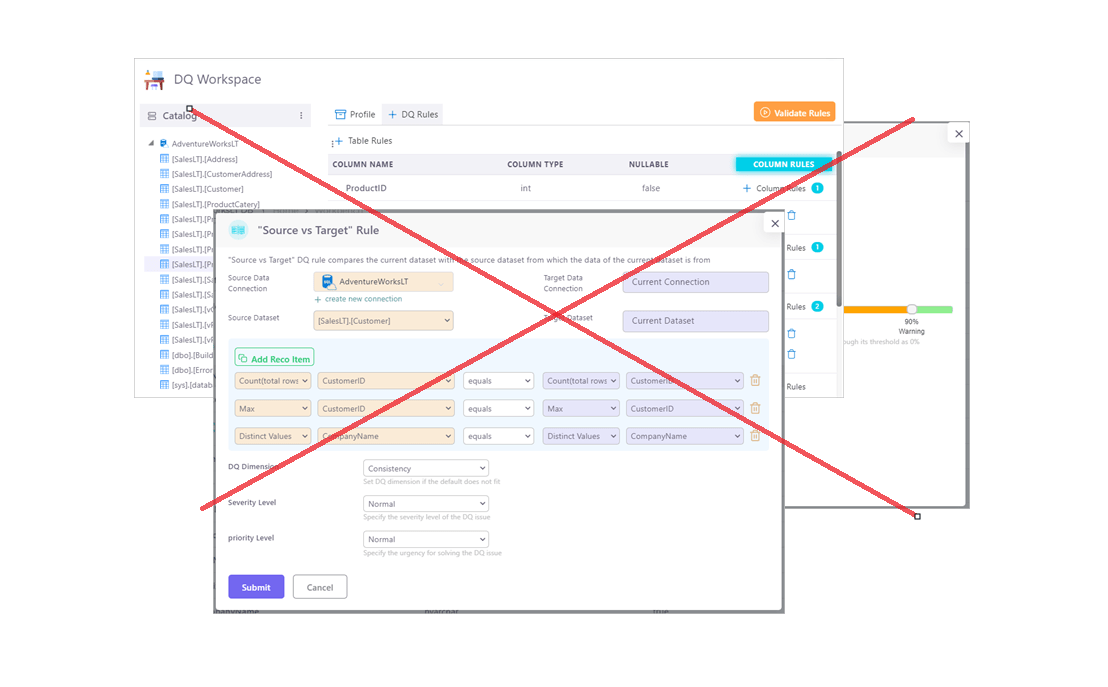
I have been planning the UX components and research engine for QuantFlow. I thought both would become key pillars of the platform. The UX layer would simplify how engineers build data pipelines and how quants interact with data. The research engine would automate large parts of the quant research workflow, allowing users to focus on … Continue reading I Was Wrong: the Users of QuantFlow Won’t be Human
QuantFlow: Brute-Force Grid Search for Stock Behaviour Patterns
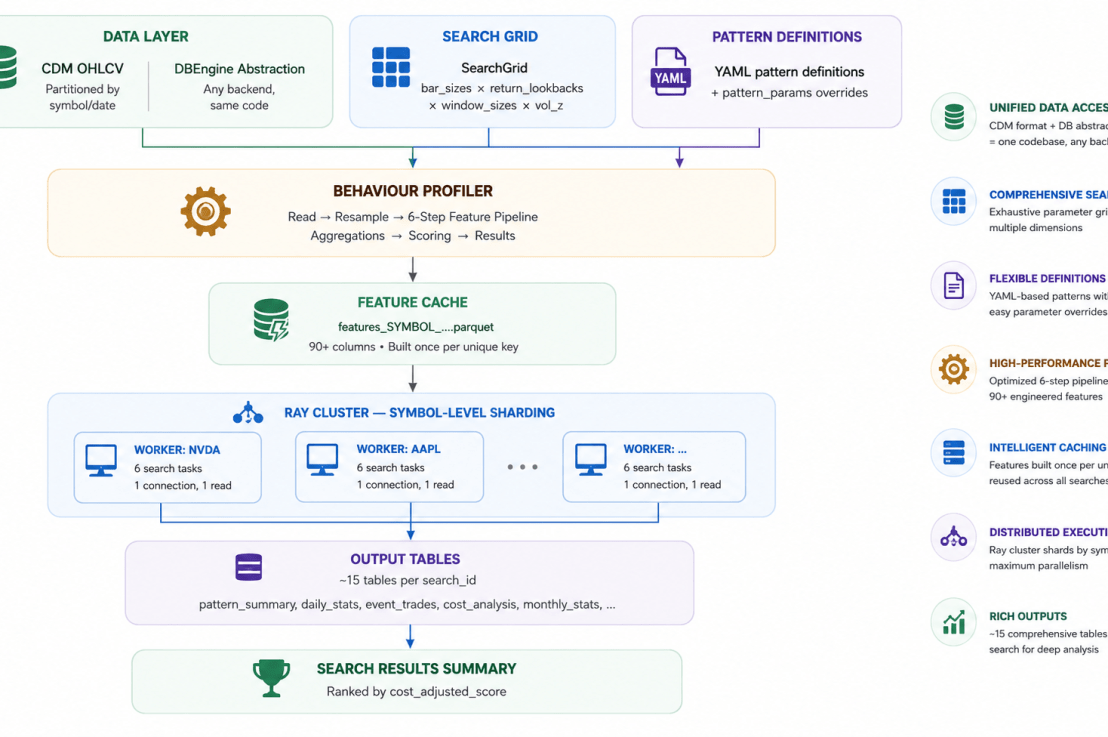
Every stock behaviour pattern has parameters. A compression breakout depends on the rolling window. A VWAP reclaim depends on the volume threshold. A failed breakout depends on the forecast horizon. Change one number and a "profitable" pattern becomes noise. The typical workflow: tweak a parameter → rerun → query results → squint at a table … Continue reading QuantFlow: Brute-Force Grid Search for Stock Behaviour Patterns
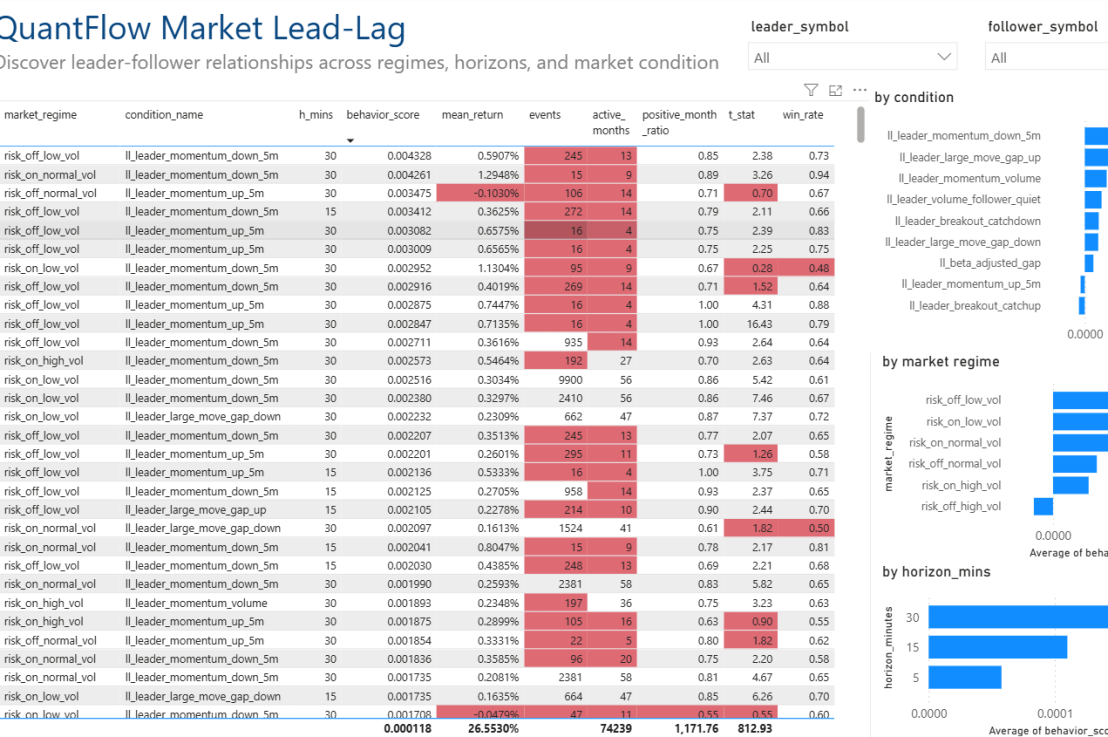
QuantFlow: Detecting Trading Opportunities Through Market Lead-Lag Profiling
Context: Some trading ideas often pop into my mind unexpectedly, but most of the time I am too lazy to investigate them further. The root cause of this "laziness" is not the effort required to explore the idea itself, but rather the amount of pre-work needed before I can actually start working on it. Collecting … Continue reading QuantFlow: Detecting Trading Opportunities Through Market Lead-Lag Profiling
S3 + Parquet + Iceberg + Trino: A Poor Man’s Market Data Platform
Before I start talking about how effective this architecture can be at reducing infrastructure costs, I should first make the old point that there is really no free lunch. Compared with commercial cloud data platforms and warehouses such as Databricks, BigQuery, and Snowflake, an open lakehouse setup requires significantly more engineering effort to build, operate, … Continue reading S3 + Parquet + Iceberg + Trino: A Poor Man’s Market Data Platform
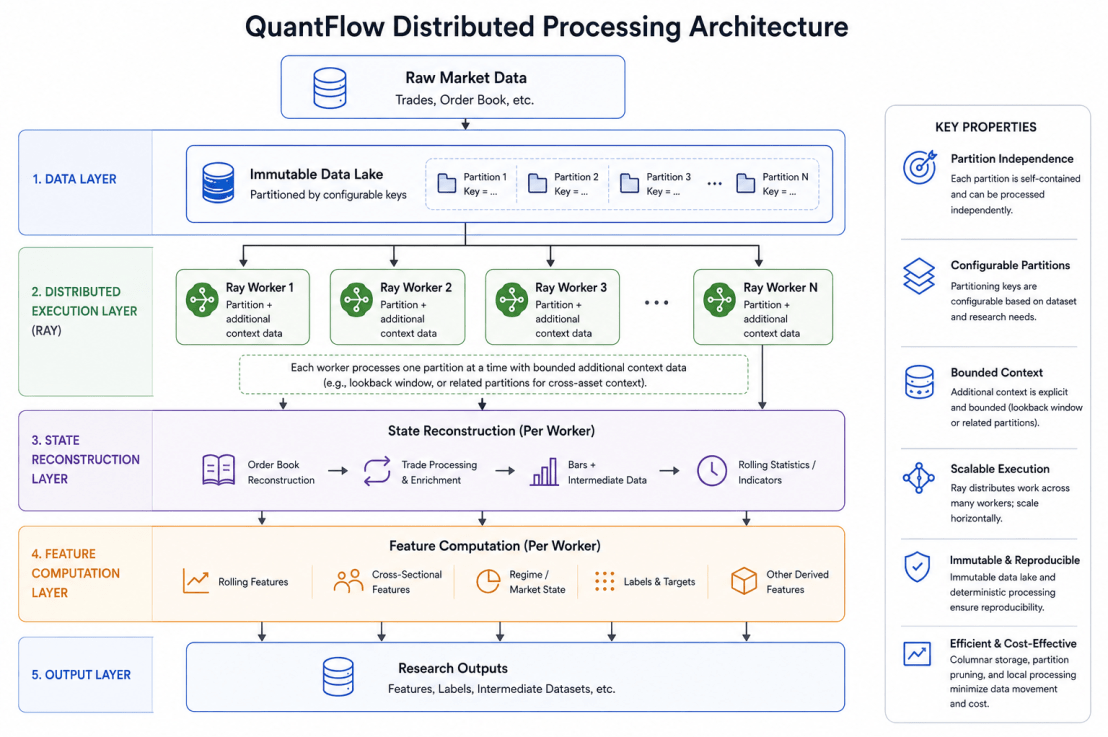
How QuantFlow Handles Large-Scale Market Data
For many years, a large portion of systematic strategies relied on relatively low-frequency signals. These approaches worked well when they were under-explored, but over time they have been widely researched, increasingly arbitraged, and structurally compressed in edge. As a result, a growing share of remaining opportunity has shifted toward market microstructure — order flow dynamics, … Continue reading How QuantFlow Handles Large-Scale Market Data
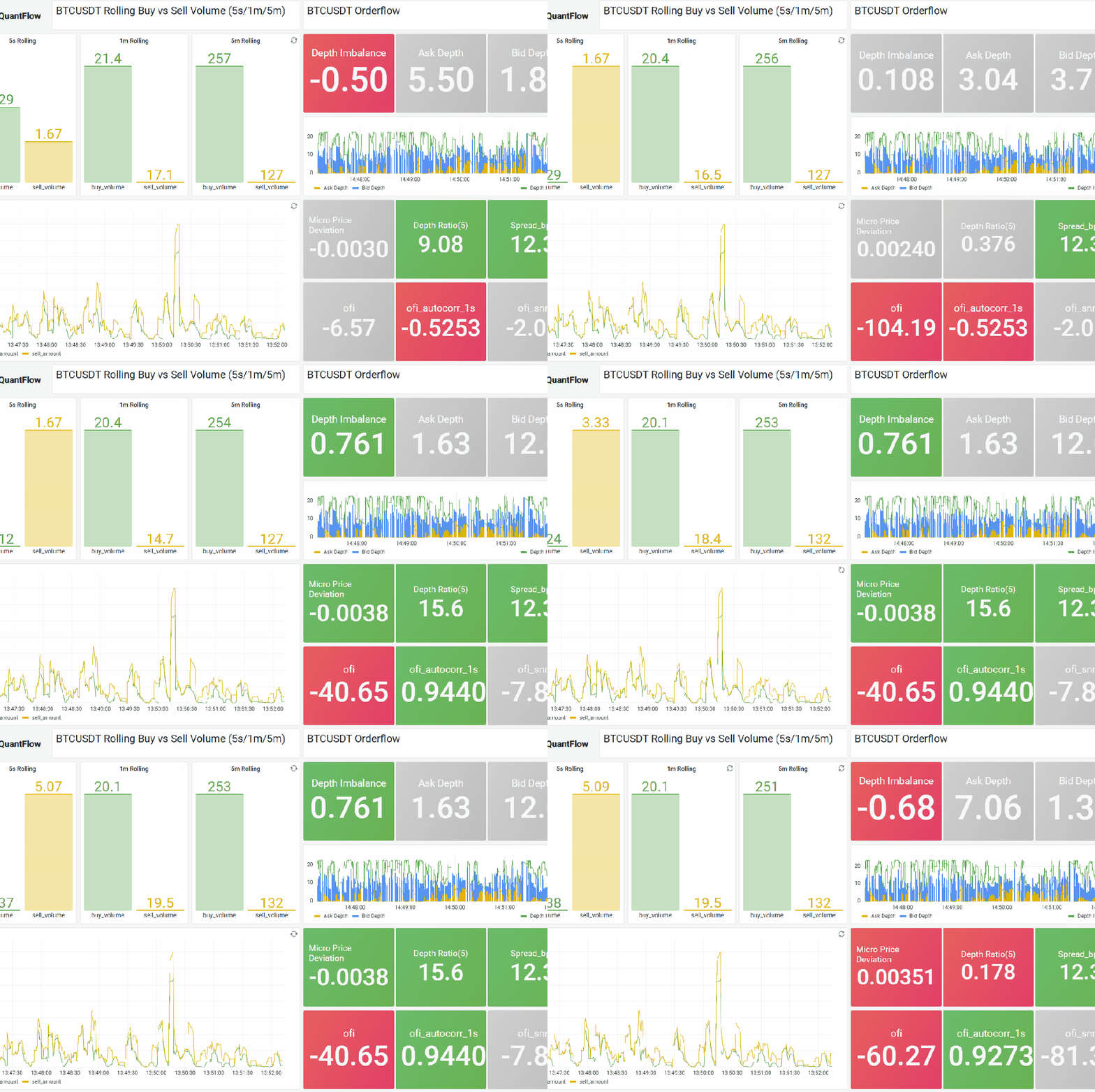
QuantFlow Fun – Build a Low-Latency Feature Monitor Dashboard
One of the reasons — actually, the core reason — I chose DolphinDB as the built-in streaming engine for QuantFlow's streaming execution layer is that it's really fast, even for the kind of complicated computation that requires chained steps. Thanks to that speed, and with QuantFlow's MarketState engine and FeatureDAG compiler on top, we can … Continue reading QuantFlow Fun – Build a Low-Latency Feature Monitor Dashboard


You must be logged in to post a comment.