Across the previous 30+ articles in this series, I have focused on the theoretical foundations behind AI-native financial data platforms, covering financial business semantics, canonical data models, knowledge graphs, GraphRAG, semantic retrieval, tool contracts and related topics. From this article onwards, I would like to shift the discussion towards the design and implementation of my … Continue reading AI-Native Financial Data Foundation (33) – Ontology Modelling Challenges in Financial Services
AI-Native Financial Data Foundation (32) – MCP: A Standard Interface for Agentic Financial Data
In the previous article, I discussed the idea of tool contracts. The core idea was simple: an AI agent should not have vague, unconstrained access to financial data systems. It should interact with those systems through explicit capabilities. Each capability should have a clear purpose, input structure, output structure, evidence expectation, and policy boundary. For … Continue reading AI-Native Financial Data Foundation (32) – MCP: A Standard Interface for Agentic Financial Data
AI-Native Financial Data Foundation (31) – Tool Contracts: Making Agent Capabilities Explicit
In the previous article, I explored a retrieval pattern for the financial semantic layer. The pattern is: user question → classify intent and extract context → scoped hybrid candidate search → entity resolution → constrained graph traversal → governed evidence → LLM explanation For governed financial semantic questions, the LLM should not freely inspect the … Continue reading AI-Native Financial Data Foundation (31) – Tool Contracts: Making Agent Capabilities Explicit

AI-Native Financial Data Foundation (30): Exploring a Retrieval Pattern for the Financial Semantic Layer
In the previous article, I raised a practical question: what should happen when a user does not use the exact field name, semantic concept, or use-case name stored in the graph? A user may ask: "Do we have the fixed coupon needed for valuation?". However, the graph may use governed names such as "FixedRate". The … Continue reading AI-Native Financial Data Foundation (30): Exploring a Retrieval Pattern for the Financial Semantic Layer
AI-Native Financial Data Foundation (29) – Cypher by Example: Querying a Financial Semantic Graph
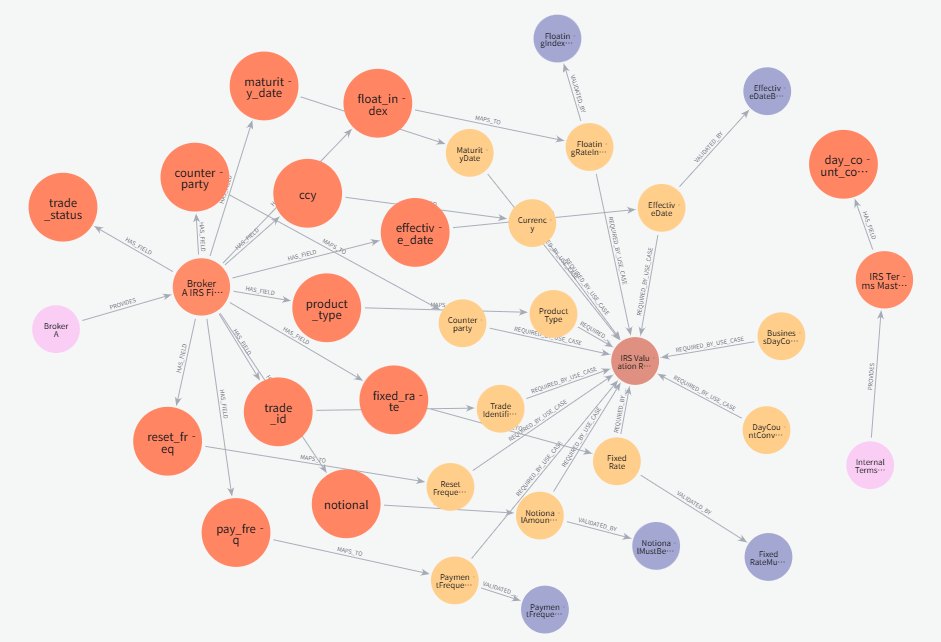
In the previous article, I looked at Neo4j as a candidate technology for modelling semantic relationships as a graph. The key idea was simple: a financial semantic model is not only a list of terms. It is a network of connected meaning. A source field may map to a semantic concept. The concept may belong … Continue reading AI-Native Financial Data Foundation (29) – Cypher by Example: Querying a Financial Semantic Graph

AI-Native Financial Data Foundation (28) – Neo4j: Modelling Semantic Relationships as a Graph
After several articles on tool-using LLMs, graph-grounded reasoning, and evidence-aware generation, I now want to move one level deeper and examine the technical building blocks required to support an Agentic Semantic Layer. The first technical question is simple: How should financial semantic meaning be modelled, stored, and exposed so that it can be queried and … Continue reading AI-Native Financial Data Foundation (28) – Neo4j: Modelling Semantic Relationships as a Graph
AI-Native Financial Data Foundation (27) – Reading Notes: Graph-Grounded Reasoning and Evidence Checking
In the previous article, I walked through several papers on tool-using LLMs and agentic orchestration. The main argument was that an AI-native financial data foundation should not rely on an LLM as a standalone answer generator. The LLM should act as an orchestrator over governed semantic capabilities: concept resolution, field discovery, product decomposition, readiness checking, … Continue reading AI-Native Financial Data Foundation (27) – Reading Notes: Graph-Grounded Reasoning and Evidence Checking
AI-Native Financial Data Foundation (26) — Reading Notes: Tool-Using LLMs and Agentic Orchestration
In the previous article, I shared my reading notes on several survey-type papers to build a broader landscape view of augmented LLMs, GraphRAG, and tool learning. Those papers were useful because they provided context. They showed that modern LLM systems are moving beyond standalone text generation. LLMs are increasingly being augmented with retrieval, tools, external … Continue reading AI-Native Financial Data Foundation (26) — Reading Notes: Tool-Using LLMs and Agentic Orchestration
AI-Native Financial Data Foundation (25) – Reading Notes: Augmented LLMs, Tool Learning and GraphRAG
Before jumping directly into the agentic semantic layer for the AI-native financial data foundation, I feel I need a bridge. I want to share my reading notes on several key papers that helped me understand this direction and shape the high-level design of the agentic semantic layer. In this post, I will focus on four … Continue reading AI-Native Financial Data Foundation (25) – Reading Notes: Augmented LLMs, Tool Learning and GraphRAG
AI-Native Financial Data Foundation (24) – “AI-Native”, not “AI-Enabled”
At this stage of the blog series, my main focus is still foundational. I am not yet writing about the design and implementation of the AI-native financial data foundation. That will come in the next stage while I am currently developing and testing the proof of concept in parallel. Before moving into architecture, components, implementation … Continue reading AI-Native Financial Data Foundation (24) – “AI-Native”, not “AI-Enabled”


You must be logged in to post a comment.